Lotus Palm (蓮花掌) and the Hand Shapes of Zen Gong
手型
Six hand shapes recur through the fourteen movements. Each has a specific tension pattern, and the shape is not decorative.
Six hand shapes recur through the fourteen movements. Each has a specific tension pattern rather than a specific outline, and the difference matters — copying the silhouette without the tension gives you the picture and none of the practice.
Why hand shape is not decoration
The obvious objection to detailed hand instructions is that the hands are at the end of the chain and cannot matter much. Anatomically that is backwards. The muscles that shape the fingers originate in the forearm, and forearm tension propagates to the elbow and shoulder. Change the hand and you change what the arm is doing.
You can test this in a few seconds. Hold your arm out with a completely loose hand, then form a taut spread palm without moving the arm. The shoulder position changes on its own.
The Laogong point勞宮
- 勞宮láo gōng
- Labour PalaceAt the centre of the palm, roughly where the middle fingertip touches when the hand closes loosely. Pericardium-8 in acupuncture numbering.
- 掌zhǎng
- PalmUsed for open-hand shapes generally, as opposed to 拳 (fist).
- 虎口hǔ kǒu
- Tiger's mouthThe web between thumb and index finger. Held open and rounded in several shapes.
Most hand instructions in the curriculum reference 勞宮 as an attention point — palms facing each other Laogong-to-Laogong, or a Laogong point directed at a body region. Treat it as a coordinate for placing attention rather than a claim about anatomy; it works either way. See Qi, Explained Without Mysticism.
The six shapes
- 01Lotus Palm · 蓮花掌
Fingers gently cupped. Index and little finger held taut; middle and ring slightly curved; palm hollow with 勞宮 at the centre. The signature shape of the gathering movements — used when the hands hold the energy sphere at the dantian.
- 02Prayer Palm · 合掌
Palms together at the chest, fingers pointing up, a small hollow retained between the palms. The heels of the hands touch; the palms do not flatten against each other.
- 03Vertical Shield · 立掌
Palm vertical, fingers up, wrist extended so the palm faces outward. Used for pressing and warding movements. The wrist extension is the active part.
- 04Knife Hand · 刀掌
Fingers straight and held together, thumb tucked alongside, the little-finger edge of the hand firm. Used in the cutting and sweeping movements of the martial section.
- 05Tiger Mouth · 虎口
Thumb and index spread wide with the web rounded and open, remaining fingers relaxed. Appears in gripping and drawing movements.
- 06Radiating Palm · 放掌
Fingers spread and extended, palm broad and slightly domed, the whole hand under light tension. Used in the expansion movements where the arms open wide.
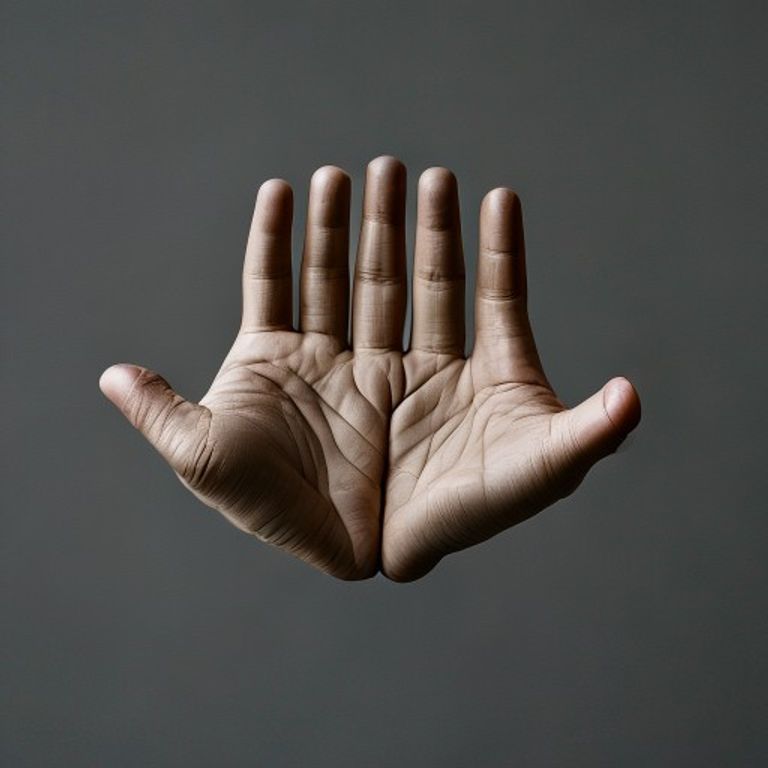
Lotus Palm in detail
It appears first in movement two of the sequence, 丹田聚氣, where the hands rise to the abdomen and hold. The lineage description is unusually precise: the hands hover roughly fifteen centimetres from the navel and roughly fifteen centimetres apart, Laogong points facing one another, with a small compression inward at the end.
The tension asymmetry is the point. Taut index and little finger with softer middle and ring produces a hand that is stable at its edges and hollow in the centre — which is why the shape is named for a lotus rather than a cup.
| Element | Correct | Incorrect |
|---|---|---|
| Index / little finger | Taut, lengthened | Curled or slack |
| Middle / ring finger | Slightly curved, soft | Rigid and straight |
| Palm centre | Hollow, domed | Flat |
| Thumb | Relaxed, following the curve | Pressed against the index |
| Wrist | Neutral | Broken forward or back |
| Forearm | Light tone only | Gripping hard |
What a camera cannot see
Pose estimation places joints, including finger joints in some configurations. It can tell whether your fingers are spread or closed. It cannot tell whether the tension distribution across them is correct, because tension has no silhouette.
This is a real and permanent limitation, and it is worth stating rather than glossing over. Hand shape is one of the elements where an app genuinely cannot substitute for a teacher putting your fingers where they belong. What the written cues can do is tell you precisely what to feel for, which is why they are unusually detailed. See Reading a Posture Score.