What Is Qigong? A Plain-English Primer
氣功入門
Slow coordinated movement, deliberate breathing, and directed attention — what qigong actually is, stripped of both mysticism and marketing.
Qigong is three things done at once: a slow coordinated movement, a deliberate pattern of breathing, and attention held somewhere specific. Remove any one of them and you have something else — calisthenics, a breathing exercise, or a daydream.
The word itself氣功
The term is younger than the practice. 氣功 in its current sense was popularised in the mid-twentieth century as a way of grouping a very large number of older practices — Daoist, Buddhist, medical and martial — under a single heading. Before that, the things now called qigong went by names specific to their lineage: 導引 (guiding and pulling), 吐納 (expelling and taking in), 內功 (internal work).
- 氣qì
- Breath, vapour, vital forceThe character shows steam rising from cooking rice. It means breath long before it means anything metaphysical. See Qi, Explained Without Mysticism.
- 功gōng
- Skill acquired through effortThe same 功 as in 功夫 (kung fu). It denotes accumulated work, not innate talent.
- 導引dǎo yǐn
- Guiding and pullingThe older name for therapeutic movement sequences. Illustrated examples survive on a silk manuscript excavated at Mawangdui.
This matters practically, not just pedantically. When someone says "I do qigong", they have told you about as much as "I do sport". The useful question is always which set, and in whose lineage.
The three components三調
Classical texts describe practice as 三調 — the three regulations, or three adjustments. Nearly every tradition organises itself around them, whatever vocabulary it uses.
- 01Regulating the body · 調身
Posture and movement. The spine is held vertical without muscular effort, the shoulders drop, the joints stay unlocked. Alignment comes first because breath and attention both degrade when structure is poor.
- 02Regulating the breath · 調息
Breathing becomes slower, deeper and quieter, and is coordinated with the movement rather than running independently of it. Usually the breath follows the movement, not the reverse.
- 03Regulating the mind · 調心
Attention is placed and kept — on a body region, on the breath, on the sensation of the movement. This is the component most often skipped, and its absence is why some people practise for years without much changing.
What it is not
- It is not stretching. Range of motion is incidental. Most sets never take a joint near its end range, and several are performed almost entirely within a comfortable middle.
- It is not a cardiovascular workout. Intensity is deliberately low. Sets that raise the heart rate substantially — Iron Body conditioning, martial flows — are the exception and are trained separately.
- It is not seated meditation. The moving body gives attention something concrete to hold, which is precisely why people who cannot sit still often get on with it. See Meditation vs Movement Meditation.
- It is not inherently religious. Some sets emerged from Buddhist or Daoist monastic settings and carry that vocabulary. The physical practice does not require the cosmology.
Where a beginner should actually start
The honest answer is: with something short, done daily, that you do not have to decide about each morning. Six to eight minutes is enough to establish the habit, and the habit is the thing that is hard — not the movements.
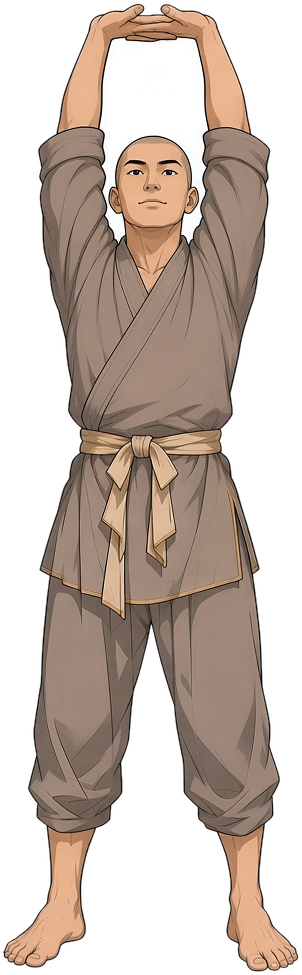
Two sets are the conventional entry points. The Eight Brocades (八段錦) is the most widely practised qigong sequence in the world and the most thoroughly documented. A short morning set of joint and breath work is even simpler and can be done cold, before anything else.
How long before anything happens
Practitioners commonly report changes in sleep and in general tension within the first few weeks, and changes in posture and balance over months rather than weeks. That ordering is worth knowing in advance: the subjective effects arrive well before the structural ones, and people who expect the reverse tend to quit in week three.
On what the published research supports — which is a narrower set of claims than the internet suggests — see Does Qigong Actually Do Anything?