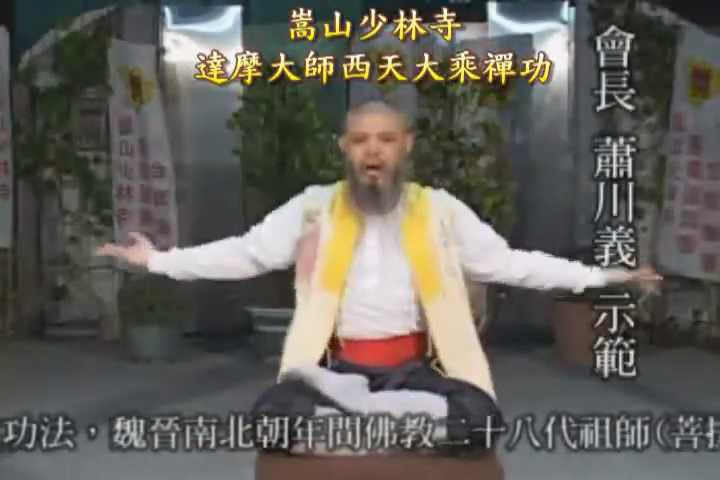
Yi Jin Jing: The Muscle-Tendon Change Classic
易筋經
The most famous text associated with Shaolin, the most frequently misattributed, and the most physically demanding thing in the curriculum.
The most famous text associated with Shaolin, the most frequently misattributed, and by a distance the most physically demanding thing in the curriculum. It is also the one most often taught as though it were gentle.
The name易筋經
- 易yì
- To change, to transformThe same character as in 易經, the Book of Changes. It implies transformation, not improvement.
- 筋jīn
- Sinew, tendonBroader than the anatomical "tendon" — it covers tendon, ligament and fascia, the whole connective apparatus.
- 經jīng
- Classic, canonical textThe same 經 as in 道德經. It marks the work as canonical rather than instructional.
Read literally: the canonical text on transforming the sinews. That is an accurate description of what the practice does — it loads connective tissue under sustained tension, which is a different stimulus from either stretching or lifting.
The attribution problem
The tradition holds that Bodhidharma left two texts at Shaolin, of which this is one. The surviving Yi Jin Jing carries a preface dated to the early seventeenth century and is generally regarded by scholars as a Ming-dynasty work — roughly a millennium after Bodhidharma is supposed to have lived.
As discussed in Bodhidharma and the Western Heaven, attributing a text to a revered founder was ordinary practice in Chinese literary transmission and is not evidence of bad faith. It does mean that "a practice Bodhidharma taught" is not a claim anyone can currently support.
How it actually works
The mechanism is isometric loading held for time. A posture is taken, tension is generated through the whole chain — often with the hands gripping or pressing against nothing — and the position is held while breathing continues.
This is why it is misleading to file it with gentle qigong. The postures look static; the effort is substantial. A properly performed Yi Jin Jing posture held for a minute is closer in feel to an isometric strength exercise than to the Eight Brocades.
| Eight Brocades | Yi Jin Jing | |
|---|---|---|
| Stimulus | Movement through mid-range | Sustained isometric tension |
| Effort | Low | High |
| Duration | 8–12 min | ~20 min |
| Held positions | Brief | Extended, 30–60s |
| Suitable cold | Yes | No — warm up first |
| Beginner-appropriate | Yes | After some months |
Principles that govern it
- Tension without holding the breath. The single hardest instruction. Generating whole-body tension while breathing freely is the skill the set teaches. If you are holding your breath, reduce the tension.
- Gradual onset. Tension builds into a posture over several seconds rather than snapping into it.
- The eyes participate. Several postures direct the gaze deliberately — following a hand, fixing on a point. This is not decorative; it changes the neck and shoulder recruitment.
- Release completely between postures. The recovery is part of the method. Moving from one held posture to the next without releasing accumulates tension you cannot then control.
- Slow progression. Connective tissue adapts more slowly than muscle. Adding hold time faster than the tendons adapt is exactly how tendinopathy happens.
Where it sits in the curriculum
Yi Jin Jing is premium material in the app, alongside Xi Sui Jing, and that placement reflects sequencing as much as pricing. It sits behind the free material because attempting it before you can hold a two-minute standing pillar with correct knee and shoulder alignment is asking for trouble.
A reasonable prerequisite: three months of consistent practice, a comfortable two-minute standing hold, and no current joint complaints.