The Complete Fourteen: A Map of Western Heaven Zen Gong
西天大乘禪功十四式
The whole sequence in one place — four phases, fourteen movements, roughly eight minutes, from first seated breath to final stillness.
The whole sequence in one place — four phases, fourteen movements, about eight minutes, from first seated breath to final stillness. This is the map; the app is the territory.
The shape of it
Most qigong sets are flat: eight or twelve movements of roughly equal character, repeated. Western Heaven Zen Gong is not flat. It has an arc — it starts still, builds to genuine vigour, and comes back down.
| Phase | Movements | Character | Position |
|---|---|---|---|
| Opening 起 | 1–4 | Still, internal, gathering | Seated |
| Expansion 開 | 5–8 | Opening outward, rising | Standing |
| Dynamic 動 | 9–12 | Vigorous, directional, martial | Standing |
| Closing 收 | 13–14 | Settling, returning | Standing, then seated |
That architecture is the argument for practising it as a whole rather than cherry-picking. The dynamic section exists so there is something to settle from; the seated closing exists to do the settling. Half the set is half a shape.
Opening起
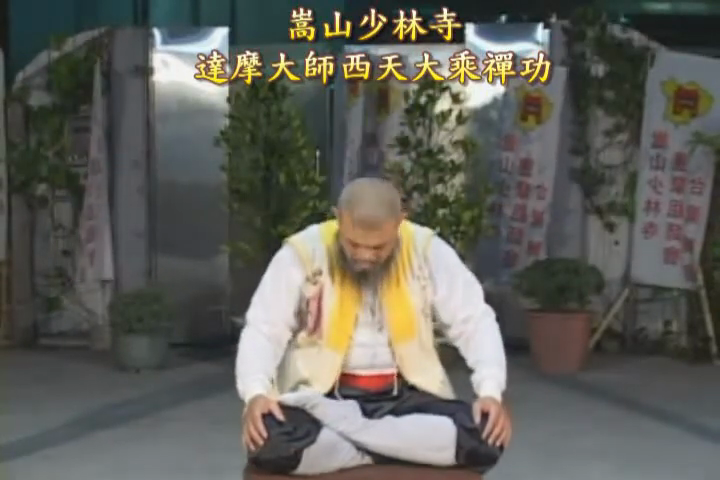
- 01Initial Seated Meditation · 坐禪入定
Full lotus if available, otherwise cross-legged or a chair. Crown suspended, shoulders dropped, palms on the knees, gaze angled 45° downward at about twenty per cent open. One deep abdominal breath sets the register for everything after.
- 02Abdominal Energy Gathering · 丹田聚氣
Wrists rotate inward, hands lift, palms turning 180° as they rise to chest height. At the apex they form Lotus Palm, hovering about fifteen centimetres from the navel and fifteen apart, then compress slightly inward.
- 03Overhead Palm Union · 高舉合掌
Palms join and travel overhead on an inhalation, arms lengthening without the ribs flaring. A vertical opening through the whole torso.
- 04Heart Center Alignment · 心口對齊
The joined palms descend to the sternum and settle. The transition from gathering to expression — the last still movement before the set opens out.
Expansion開
- 01Universal Expansion · 展開天地
Arms open wide to the sides, palms radiating, chest opening. The widest shape in the sequence, and the point at which the set moves from internal to external.
- 02Lateral Protective Flow · 側身護流
The body turns and one arm sweeps across in a continuous protective arc. The first movement with a martial reading.
- 03Directional Side Thrust · 側方推掌
A palm thrusts laterally from a rooted stance, generated from the ground rather than the shoulder. Direction becomes explicit here.
- 04Radiant Ascent · 光明上升
Arms rise and open upward, expanding through the whole front line of the body. The peak of the expansive phase.
Dynamic動
- 01High-Low Guarded Stance · 上下護身
One hand high and one low, guarding two lines simultaneously. Weight distribution and structure are tested more here than anywhere else.
- 02Circular Arm Transmutation · 環臂轉化
Large continuous circles through the arms and waist, the movement changing direction without stopping. The most flowing movement in the set.
- 03Horizontal Sweeping Push · 橫掃推掌
A broad lateral sweep transitioning into a press. Generated from the waist; the arms carry rather than drive.
- 04Dynamic Zen Boxing · 禪拳合一
The martial section, and the vigorous peak of the sequence. See Warrior Flow for why a meditation set contains strikes, and how to practise them without hurting an elbow.
Closing收
- 01Closing Integration · 收功歸一
The energy of the dynamic section is gathered and brought back to centre. Hands descend on long exhalations. This is the movement that makes the set safe to end.
- 02Final Seated Stillness · 靜坐圓滿
Return to the seated posture the sequence began in. Sit for one to five minutes. The attention gathered by the preceding thirteen movements is what makes this sit different from a cold one — see Meditation vs Movement Meditation.
How to learn it
- Do not start here. Begin with the morning set and establish a daily habit first. See A 30-Day Beginner Path.
- Learn the opening four alone for a week or two. They are seated and internal and they set the register.
- Add the expansion phase next. Standing work, wider shapes, more demand on the stance.
- Add the dynamic phase slowly. Practise movement twelve at low speed for weeks before adding any vigour.
- Never drop the closing. Even when short of time, movements thirteen and fourteen stay.
How long does the full sequence take?
Do I need to be able to sit in full lotus?
Can I practise just part of it?
Is the whole sequence free?
How is it different from the Eight Brocades?
What does the name mean?
Practise this form: Western Heaven Zen Gong (Complete) · 西天大乘禪功